

An L-shaped sofa can make a living room more comfortable by bringing seating together in one corner and leaving the rest of the space open. But choosing the wrong size can have the opposite effect. A sofa that looks perfectly proportioned in a showroom or product photograph may take up too much room at home, block a walkway or leave very little space for a coffee table.
The right size depends on more than the length of your wall. You also need to consider the room’s shape, the position of doors and windows, the direction of the chaise and how much space people need to move around.
So, should you choose a compact L-shaped sofa for a small living room or a larger one for a spacious layout? Let’s look at the measurements, layout considerations and practical differences that can help you decide.
What Is the Best L Shape Sofa Size for a Small Living Room?
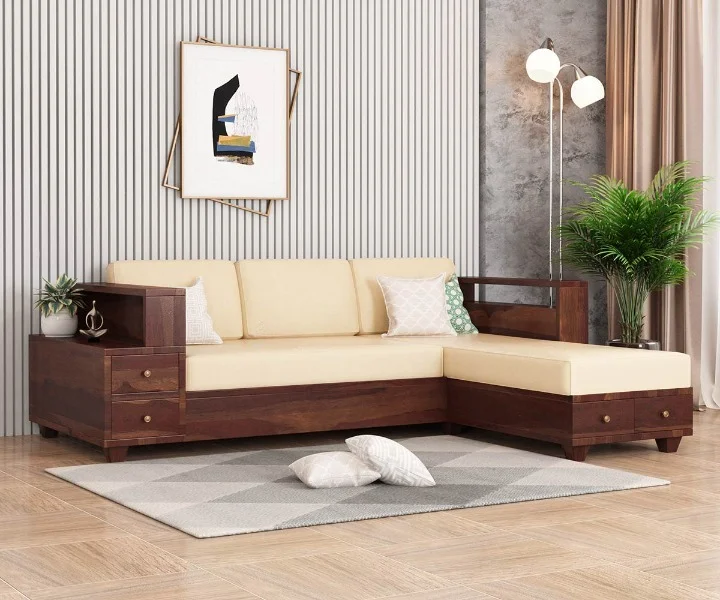
L Shaped Solid wood Sofa Set with Drawer
For a small living room, the best L-shaped sofa is one that provides enough seating without taking over the available floor space.
As a starting point, you can explore compact configurations with an overall length of around 6–7 feet and a shorter return or chaise. These are approximate planning dimensions, not fixed industry standards. Actual dimensions differ between designs and manufacturers.
Before choosing a sofa, consider:
- Room width: Make sure the sofa does not leave the opposite side of the room too cramped.
- Chaise length: A shorter chaise may be more practical when the room is narrow.
- Armrest design: Slim arms can provide more usable seating without increasing the overall width.
- Back height: A lower-profile design can help a compact room feel more open.
- Walking space: Leave enough room to reach doors, windows and other furniture comfortably.
A compact L-shaped sofa is particularly useful when you want corner seating but do not have enough space for a separate sofa and armchair.
What Is a Good L-Shaped Sofa for a Small Living Room?
A good L-shaped sofa for a small living room should fit into a corner, offer comfortable seating and leave enough space for everyday movement.
Here are some designs worth considering.
Solid Wood Cube L Shape Sofa
1. Compact L-Shaped Sofa
A compact design with a shorter chaise is a sensible choice for a small apartment or a living room with limited floor space. It provides the corner seating arrangement without extending too far into the room.
2. L-Shaped Sofa with Slim Arms
Wide armrests can take up valuable space. A sofa with slimmer arms may offer more seating within a similar overall footprint.
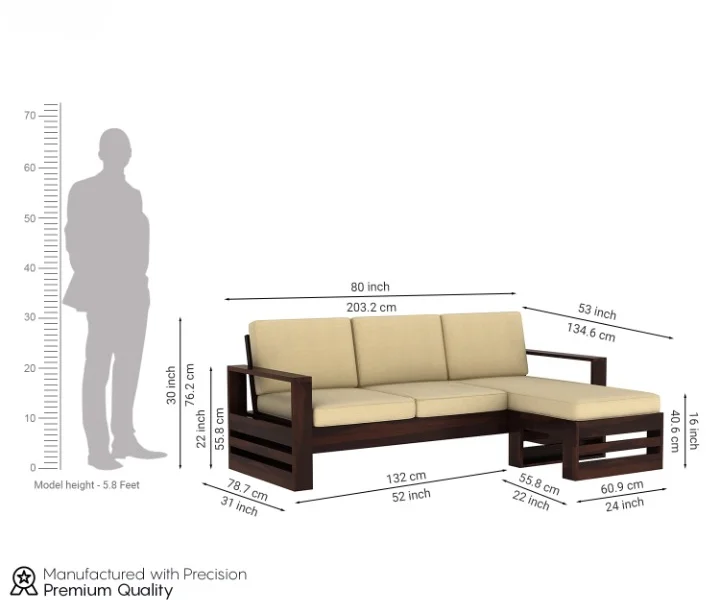
Solid Wood L-Shape Winster Multifunctional Corner Sofa
3. Low-Profile L-Shaped Sofa
A sofa with a lower back and simple lines can create a lighter visual appearance. This can be helpful when the room already has a television unit, centre table or other large furniture.
4. Reversible or Flexible Chaise Configuration
If the layout allows it, a reversible chaise can offer flexibility when rearranging furniture. However, check the actual product configuration before buying. Not every L-shaped sofa can be switched from left-facing to right-facing.
Practical tip: Do not choose a compact sofa only because its overall length looks suitable. Check both the long side and the return side. The return is the section that extends into the room and can affect walking space.
What Size L Shape Sofa Is Suitable for a Large Living Room?
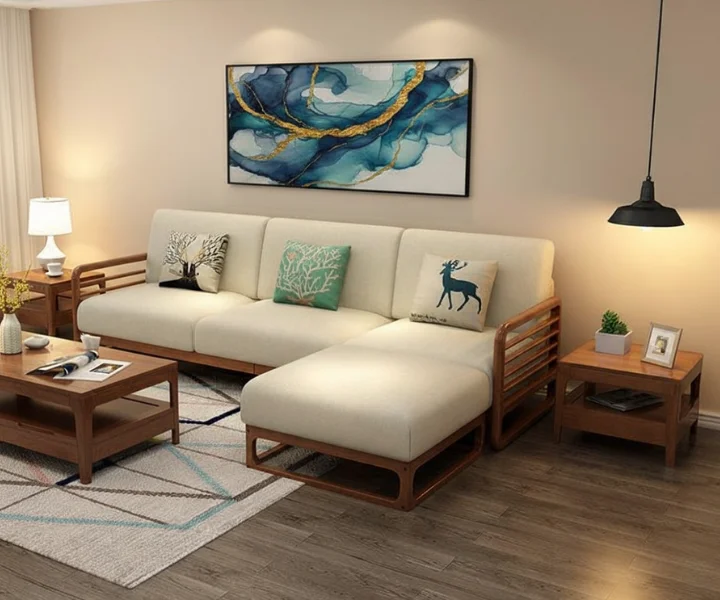
Solid Wood L Shape Sofa Modern Sofa Set Design
A large living room gives you more flexibility. You can consider a wider L-shaped sofa with a longer chaise, deeper seats or additional seating capacity.
As a broad planning reference, larger configurations may have a main length of around 8–10 feet or more, depending on the design. The return section may also be longer. These are illustrative size ranges, not standard measurements.
A larger sofa can work well when:
- The living room has enough floor space for a longer seating arrangement.
- You regularly have family or guests over.
- You want the sofa to be the main focal point of the room.
- There is enough room for a centre table and additional furniture.
- The layout allows people to move around the sofa without squeezing through narrow gaps.
However, a large room does not automatically require the biggest sofa available. A sofa that is too small can look lost in a spacious room, while an oversized one can make the layout feel crowded.
The aim is to create a balanced seating area.
Small vs Large Living Room: Which L Shape Sofa Should You Choose?
The following comparison can help you narrow down the right configuration.
| Consideration | Small living room | Large living room |
|---|---|---|
| Sofa configuration | Compact L shape | Wider or extended L shape |
| Main length | Around 6–7 feet as a starting point | Around 8–10 feet or more, depending on layout |
| Chaise | Shorter return | Longer return can work |
| Armrests | Slim or simple | Wider designs may fit |
| Visual style | Minimal and light | Larger or more substantial designs |
| Additional seating | Avoid overcrowding | Accent chairs may be possible |
| Coffee table | Compact centre table | Larger centre table, if space allows |
These dimensions are approximate planning examples. Always use the actual external measurements of the sofa you intend to buy.
What Is the Standard L Shape Sofa Size?
There is no single standard L shape sofa size. Dimensions vary depending on the number of seats, chaise length, armrest width, seat depth and overall design.
For initial room planning, these approximate ranges can be useful:
| Sofa configuration | Approximate planning range |
|---|---|
| Compact L-shaped sofa | 6–7 feet main length |
| Medium L-shaped sofa | 7–9 feet main length |
| Large L-shaped sofa | 9–10 feet or more main length |
The return or chaise section also varies and needs to be measured separately. These figures are general planning references, not guaranteed product specifications.
When comparing sofas online, look for the complete dimensions, including:
- Overall length of the main section
- Overall length of the return
- Total depth
- Seat depth
- Backrest height
- Armrest width
A product described as a five-seater, for example, may have different dimensions from another five-seater because seating capacity does not determine the exact size.
How to Measure Your Living Room Before Buying an L Shape Sofa
Measuring your room before selecting a sofa can save you from a common problem: finding out that the sofa fits against the wall but makes the rest of the room difficult to use.
Follow these steps.
Step 1: Measure the Main Wall
Measure the wall where you plan to place the longer side of the sofa. Note any windows, electrical points, doors or wall features that could affect placement.
Step 2: Measure the Return Side
An L-shaped sofa extends into the room along a second side. Measure how much space is available for this section.
Do not forget to account for nearby doors, passages or furniture.
Step 3: Mark the Sofa Footprint
Use masking tape or newspaper to mark the approximate length and depth of the sofa on your floor.
This gives you a much better idea of how much space the sofa will occupy than looking at a photograph.
Step 4: Leave Enough Walking Space
Try to maintain around 30–36 inches for important walking routes where possible. In tighter layouts, the available clearance may be less, but avoid blocking frequently used passages.
Also consider the space between the sofa and coffee table. Around 14–18 inches is a useful starting point for comfortable access, although the ideal distance depends on the furniture and room layout.
Step 5: Check the Delivery Route
Measure doorways, staircases, lifts and turns along the delivery route. A sofa may fit perfectly in your living room but still be difficult to bring inside if the entrance is narrow.
Left-Hand or Right-Hand L Shape Sofa: Which One Should You Choose?
The direction of the chaise matters just as much as the overall size.
A left-hand or right-hand configuration generally refers to the side on which the extended section sits when viewed from the specified orientation. However, sellers may describe orientation differently, so always check the product’s diagram or measurement guide.
Before choosing:
- Identify the corner where you want to place the sofa.
- Check which side has the television unit or main focal point.
- Make sure the chaise does not block the main entrance or passage.
- Consider how people will move between the sofa, coffee table and other seating.
If you are unsure, sketch the room layout and mark the sofa’s position before ordering.
Which Coffee Table Works Best with an L-Shaped Sofa?
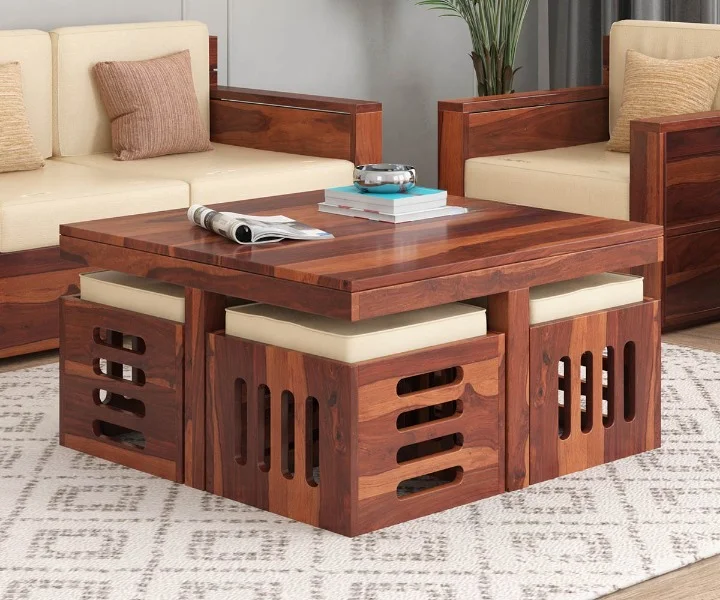
Solid Wood Coffee Table Sets
A coffee table should complement the sofa without making the seating area difficult to use.
For a compact L-shaped sofa, a small rectangular, round or oval coffee table can work well. Round edges can also make movement around the table easier in tighter layouts.
For a larger L-shaped sofa, you can consider a wider rectangular table or a larger centre table, provided there is enough clearance around it.
A useful starting point is to choose a coffee table that is around two-thirds of the sofa’s main seating length, then check whether it fits comfortably within the seating arrangement. This is a proportion guideline rather than a fixed rule.
You can explore different coffee table designs and compare their dimensions with your sofa before deciding.
L Shape Sofa vs 3 Seater Sofa: Which Is Better for Your Room?
Both designs can work well, but they serve slightly different layout needs.
| Factor | L-shaped sofa | Three-seater sofa |
|---|---|---|
| Seating arrangement | Uses two connected sides | Uses one straight seating line |
| Corner placement | Makes use of a corner | Can be placed along a wall |
| Room requirement | Needs space for the return | Usually easier to fit into narrow layouts |
| Seating layout | Creates a defined seating area | Offers flexibility with separate chairs |
| Best suited for | Rooms with a suitable corner | Small, medium or narrow living rooms |
If your living room has a suitable corner and you want more connected seating, an L-shaped sofa may be a better fit. If you want flexibility to move furniture around, a three-seater sofa can be easier to arrange.
You can compare options in the 3 Seater Sofa Collection.
Common Mistakes to Avoid When Choosing an L Shape Sofa
Even a well-designed sofa may not work if it is the wrong size for the room. Avoid these common mistakes:
- Measuring only one side: The return section also needs enough space.
- Ignoring the chaise direction: The wrong orientation can block a passage or make the layout awkward.
- Choosing by seating capacity alone: Two sofas with the same number of seats can have very different dimensions.
- Forgetting the coffee table: The sofa should leave enough room for a centre table and comfortable access.
- Ignoring delivery access: Check whether the sofa can pass through your entrance, staircase or lift.
- Buying based only on photographs: Always compare the listed measurements with your room dimensions.
Frequently Asked Questions
1. What is the best size sofa for a small living room?
A compact sofa with a main length of around 6–7 feet can be a useful starting point for a small living room. The ideal size depends on the room’s width, the chaise length and the space needed for walking. Always measure the complete sofa footprint before buying.
2. What is a good L-shaped sofa for a small living room?
A compact L-shaped sofa with a shorter return, slim armrests and a simple design is often a practical choice. It provides corner seating without occupying as much floor space as a larger configuration.
3. What is the 2/3 rule for sofas?
The 2/3 rule is a proportion guideline suggesting that a sofa can be around two-thirds of the wall length behind it. For an L-shaped sofa, also check the return section and walking clearance. It is not a fixed sizing requirement.
4. What is the standard L shape sofa size?
There is no universal standard size. Compact designs may have a main length of around 6–7 feet, while larger designs may extend to 9–10 feet or more. The return, depth and overall dimensions vary by manufacturer and model.
5. Is an L-shaped sofa suitable for a narrow living room?
It can be, provided the room has enough width for the return section and a clear walking route. A compact design with a shorter chaise may work better than a deep, oversized configuration.
6. Should an L-shaped sofa touch the wall?
It does not always need to touch the wall. Placing it slightly away from the wall can work in larger rooms, while positioning it against a wall may save space in smaller rooms. The best arrangement depends on the room layout.
7. How much space should be between an L-shaped sofa and a coffee table?
Around 14–18 inches is a useful starting point. This allows people to reach the table while keeping it close enough for everyday use. Adjust the distance according to the table size and available walking space.
Final Thoughts
The best L-shaped sofa is not necessarily the biggest one or the one with the most seats. It is the one that fits your room, supports your everyday routine and leaves enough space to move comfortably.
For a small living room, a compact configuration with a shorter return and slimmer arms may be the practical choice. For a larger space, a wider sofa with an extended chaise can create a more complete seating area.
Before making a decision, measure both sides of the sofa, check the chaise direction and consider the space needed for a coffee table and walkways.
If you are comparing different styles and configurations, explore the L Shape Sofa Collection and the wider Mamta Furniture Sofa Collection to review available designs and their individual dimensions.
For more info, contact: Support@mamtafurniture.in
Follow our Instagram : Mamta Furniture